
How to Safely Ship Lab Specimens in Columbus: A Complete Guide for Healthcare Providers
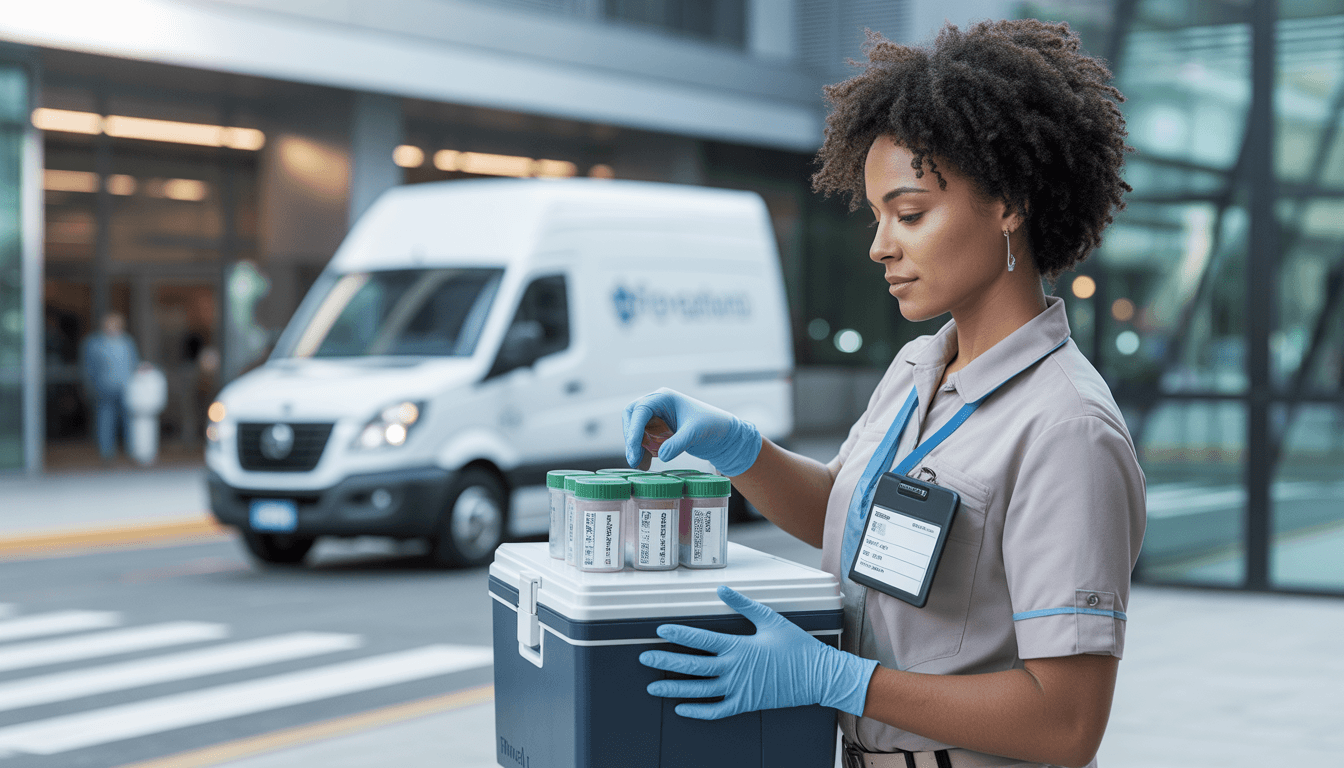
Let me ask you something: When was the last time you thought about what happens to a blood sample after it leaves your clinic?
You probably don’t lose sleep over it. You collect the specimen, label it, hand it to a courier, and assume it will arrive at the lab in perfect condition.
But here is the truth that keeps lab managers up at night: How you ship a specimen directly determines whether the test results are accurate.
A mishandled sample doesn’t just waste time and money. It can mean a repeated blood draw for a sick patient, a delayed cancer diagnosis, or—in the worst cases—a treatment decision based on bad data.
In this guide, we’re going to walk through exactly how to ship lab specimens safely and compliantly in Columbus, Ohio. We’ll cover the regulations, the packaging requirements, the temperature controls, and the questions you need to ask before you trust any courier with your patients’ samples.
Let’s get into it.
Why Specimen Transport Is More Complicated Than You Think
Most people assume shipping a blood sample is like shipping a package of steaks. Keep it cold, get it there fast, and you are done.
That assumption is dangerously wrong.
Medical specimens are classified as biological substances under federal regulations. Depending on what you are shipping, different rules apply for packaging, labeling, documentation, and personnel training .
The stakes are high for three specific reasons:
1. Sample Integrity Equals Patient Safety
A specimen that gets too hot, too cold, or shaken around too much can degrade. Hemolysis (the breakdown of red blood cells) is one of the most common reasons labs reject samples. And hemolysis usually happens during transport—not at the collection site .
When a lab rejects a sample, someone has to call the patient and say, “We need you to come back for another draw.”
That patient is already sick. They are already stressed. And now they have to rearrange their schedule, find transportation, and sit through another needle stick because the courier didn’t use the right ice packs.
2. Regulatory Compliance Is Mandatory
OSHA, DOT, HIPAA, and IATA all have something to say about how you move medical specimens .
- OSHA’s Bloodborne Pathogen Standard requires proper handling, training, and personal protective equipment for anyone touching specimens.
- DOT’s Hazardous Materials Regulations (49 CFR Parts 171-180) govern how Category B biological substances (UN 3373) must be packaged and labeled.
- HIPAA requires that any patient information attached to the specimen remains confidential during transport .
If your courier isn’t trained in all three of these areas, you are assuming the legal risk for anything that goes wrong.
3. The “Gig Economy” Problem
Here is something that might surprise you: Many healthcare providers have accidentally used ride-share drivers or gig-economy couriers to transport specimens because they were cheap and available.
Those drivers have zero training in biohazard handling. They don’t carry spill kits. They don’t know what UN 3373 means. And they certainly don’t have a Business Associate Agreement (BAA) for HIPAA compliance .
If a ride-share driver gets into an accident and a blood sample leaks everywhere, who is liable? Spoiler alert: It’s not the driver. It’s the healthcare provider who hired them.
The Gold Standard: Triple Packaging for Category B Specimens
Most diagnostic specimens—blood, urine, swabs, tissue samples—fall under the Category B biological substances classification (UN 3373). These are materials that are reasonably believed not to cause permanent disability or life-threatening disease if exposed, but they still require specific handling.
The DOT and IATA require triple packaging for all Category B shipments. Here is what that means in plain English:
Layer 1: The Primary Receptacle
This is the tube, vial, or container that actually holds the specimen. It must be:
- Leak-proof (screw-top lids are better than snap caps)
- Properly labeled with the patient information or barcode
- Sealed tightly before anything else touches it
Pro tip: Tape the lid shut. A little piece of lab tape across the cap adds a surprising amount of security.
Layer 2: The Secondary Packaging
This is where things get specific. The primary container goes inside a second, leak-proof container—usually a sturdy plastic bag or a small transport tube.
Between the primary and secondary containers, you must place enough absorbent material to soak up the entire contents of the primary container if it breaks .
Think about that for a second. If you are shipping 5 mL of blood, you need enough absorbent padding to handle 5 mL of liquid. Cotton balls, cellulose wadding, or super-absorbent packets all work.
Layer 3: The Outer Packaging
The outer box or shipping bag is the last line of defense. It must be:
- Rigid and durable enough to survive normal transport handling
- Marked with the UN 3373 diamond (a specific warning symbol)
- Labeled with the words ”BIOLOGICAL SUBSTANCE, CATEGORY B”
The outer packaging also needs to hold the requisition forms or any paperwork. And here is a critical detail: The warning diamond must remain fully visible even when the package is sealed. No tape covering the corners.
What About Dry Ice or Frozen Specimens?
If you are shipping frozen samples, you have additional requirements. Dry ice (UN 1845) is itself a hazardous material under DOT regulations. The outer packaging must:
- Be designed to allow carbon dioxide gas to escape (never seal a dry ice container completely—it can explode)
- Include a dry ice label with the net weight of dry ice clearly marked
- Be handled by drivers with specific hazmat training
Temperature Control: The Silent Killer of Specimens
You can follow every packaging rule perfectly, but if the temperature is wrong, the sample is worthless.
Different specimens have different temperature requirements:
| Specimen Type | Required Temperature | Common Method |
|---|---|---|
| Most blood work (CBC, CMP, etc.) | Ambient (room temperature) or refrigerated (2-8°C) | Gel ice packs |
| Urine samples | Refrigerated (2-8°C) | Gel ice packs |
| Frozen plasma or serum | Frozen (-20°C or colder) | Dry ice |
| Biopsies for pathology | Ambient or refrigerated | Depends on fixative |
| Microbiology cultures | Ambient (body temperature preferred) | Body warmers or insulated containers |
The biggest mistake I see healthcare providers make? Using frozen ice packs for samples that only need to be refrigerated.
Frozen packs can actually freeze a refrigerated specimen, causing cell lysis and ruining the test. You need the right temperature for the right sample .
The Ice Pack Rule You Cannot Ignore
Here is a simple rule: Never let the ice pack touch the specimen directly.
Place a barrier—paper towel, bubble wrap, or the secondary container itself—between the cold pack and the sample. Direct contact can cause localized freezing or temperature swings that compromise integrity .
Real-Time Temperature Monitoring
The best couriers today use IoT-enabled data loggers or smart sensors that track temperature continuously throughout transit . If the temperature goes outside the acceptable range, the system sends an alert, and the logistics team can take corrective action immediately.
Without monitoring, you will never know if a specimen was compromised. You will just get the lab result (or the rejection notice) and wonder what happened.
What to Look For in a Columbus Medical Courier for Specimens
Not all couriers are created equal. If you are shipping lab specimens in Columbus, here is the checklist you need to run through before signing a contract:
1. Do They Have OSHA Bloodborne Pathogen Training?
Every single driver who touches specimens must have documented training under OSHA’s Bloodborne Pathogen Standard (29 CFR 1910.1030) .
Ask to see the training records. If they hesitate or give you a blank look, walk away.
2. Do They Carry Spill Kits?
Accidents happen. A compliant medical courier carries a spill kit in every vehicle—gloves, absorbent powder, disinfectant wipes, biohazard bags, and instructions for safe cleanup .
If a driver does not have a spill kit, they are not prepared for the reality of the job.
3. Do They Have DOT Hazmat Certification?
Drivers handling Category B specimens (UN 3373) or dry ice (UN 1845) need DOT hazardous materials training. This certification must be renewed every three years .
Without it, the driver is operating illegally, and you are sharing the liability.
4. Do They Sign a Business Associate Agreement (BAA)?
Under HIPAA, any courier handling protected health information (which includes patient labels on specimens) must sign a BAA with your organization .
This agreement spells out exactly how patient data is protected during transport. If a courier refuses to sign a BAA, they are telling you they don’t take HIPAA seriously.
5. Do They Offer STAT and Scheduled Options?
Some specimens are routine. Others are STAT—urgent samples that need to reach the lab immediately.
A good medical courier offers both. They should have a dispatch system that can send a driver within minutes for critical samples, plus reliable scheduled routes for daily pickups .
Common Specimen Shipping Mistakes (And How to Avoid Them)
Even experienced healthcare providers make these errors. Here are the ones I see most often:
Mistake #1: Using Standard Mail or 2-Day Shipping
Overnight courier service is the gold standard. Two-day shipping introduces too much risk. The ice packs melt, the temperature fluctuates, and the sample degrades .
The fix: Budget for overnight or same-day courier services for all clinical specimens. If the test matters, the shipping method should reflect that.
Mistake #2: Forgetting the Absorbent Material
I cannot tell you how many rejected samples come back with a note that says “leaked during transport.”
The fix: Always, always put absorbent material between the primary and secondary containers. Enough to soak the entire sample volume.
Mistake #3: Incomplete Paperwork
Lab requisitions that are missing patient information, collection times, or test codes cause delays and confusion.
The fix: Create a standardized requisition checklist and verify it before sealing the outer package.
Mistake #4: Assuming “It Will Be Fine”
This is the most dangerous mistake of all.
“It’s just a short drive across Columbus.”
“The courier said they do medical deliveries sometimes.”
“We have never had a problem before.”
Complacency kills sample integrity. Every shipment deserves the same level of care, every single time.
The Bottom Line for Columbus Healthcare Providers
Shipping lab specimens safely is not complicated, but it does require attention to detail and a commitment to doing things right.
The three-layer packaging system is non-negotiable. Temperature control is non-negotiable. Using a trained, certified, HIPAA-compliant courier is non-negotiable.
In Columbus, you have options. But not every courier who says “we do medical deliveries” actually understands what that means.
Ask the hard questions. Verify the training. Check for the BAA. And never, ever assume that cheaper or faster is better when patient safety is on the line.
Because at the end of the day, that specimen in the tube represents a real person waiting for answers. They deserve a courier who treats their sample with the same care you do.