
Ensuring Temperature Control in Medical Deliveries: A Complete Guide for Healthcare Providers
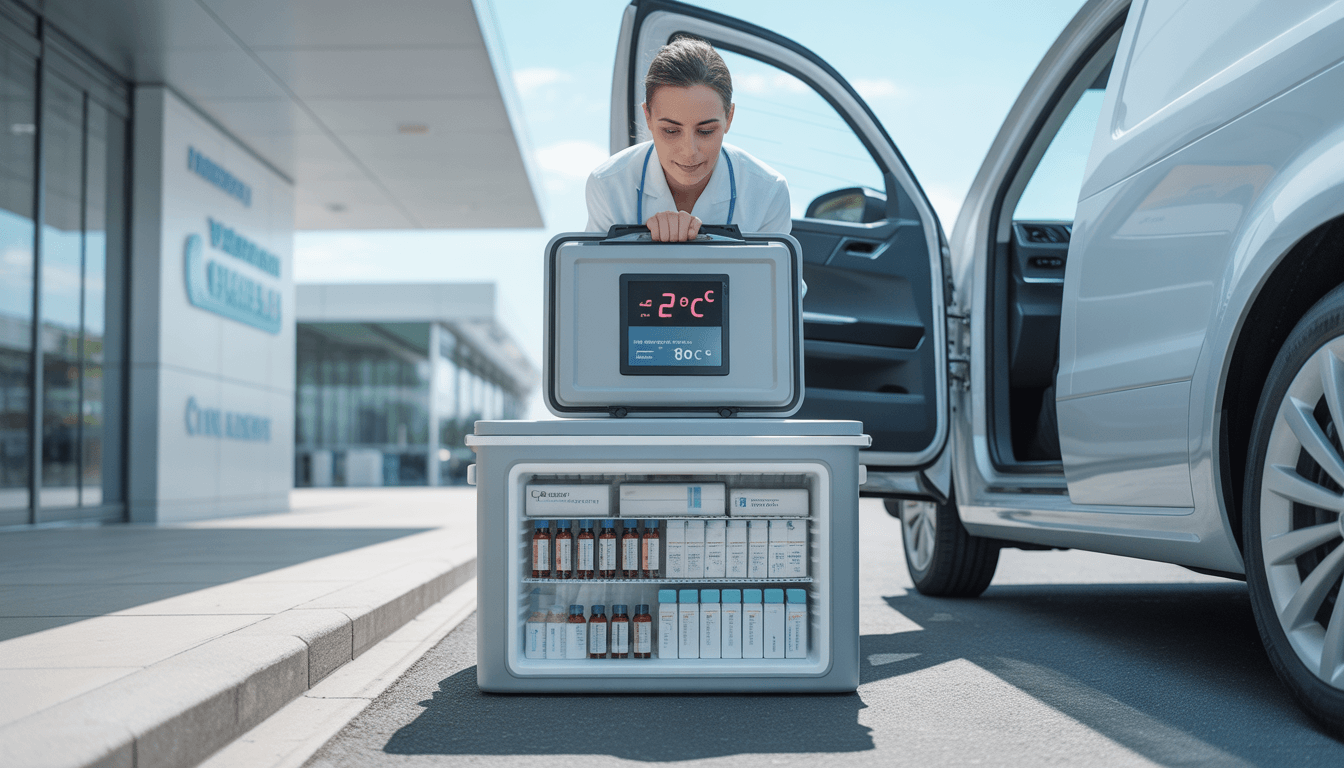
Let me ask you something that keeps logistics managers up at night: What happens to a $10,000 biologic if your delivery van’s refrigerator fails for just two hours?
The honest answer is terrifying. That expensive medication could become completely useless. Even worse, if it gets administered to a patient, it might cause serious harm.
Temperature control in medical deliveries isn’t just about following rules. It’s about protecting patients, preserving expensive products, and keeping your healthcare organization out of regulatory hot water. In this guide, we’ll walk through everything you need to know about maintaining the cold chain, from understanding temperature requirements to implementing real-time monitoring solutions.
Let’s dive in.
What Is Cold Chain in Healthcare Logistics?
Cold chain shipping ensures temperature-sensitive healthcare products remain viable during transit . In plain English, it’s a temperature-controlled supply chain that keeps vaccines, blood products, biologics, and medications within their required temperature ranges from the moment they leave the manufacturer to the moment they reach the patient.
Think of it like a chain. Every link – storage, packaging, transportation, and delivery – must stay strong. If one link breaks, the entire chain fails.
Here’s what typically moves through the medical cold chain:
- Vaccines and insulin: Usually require 2°C to 8°C (refrigerated range)
- Blood products and certain biologics: Need -20°C or lower (frozen range)
- mRNA therapies (like some COVID-19 vaccines): Require ultra-low temperatures of -70°C to -80°C
- Organs for transplant: Have strict time-temperature limits measured in hours
The global demand for cold chain logistics rose 15% in 2025 according to WHO data. That’s not surprising when you consider how many life-saving medications simply cannot survive without precise temperature control.
The Critical Temperature Ranges You Need to Know
Not all medical products are created equal. Each has specific temperature requirements, and mixing them up can be disastrous.
Here are the standard ranges used in healthcare logistics :
| Temperature Range | Target Products | Common Packaging | |
|---|---|---|---|
| Controlled Room Temperature (CRT) | 20-25°C (68-77°F) | Stable oral medications, some diagnostics | Gel packs, insulated shippers |
| Refrigerated | 2-8°C (35-46°F) | Vaccines, insulin, most biologics | Vacuum insulation panels, gel packs |
| Frozen | -20°C (-4°F) | Some APIs, certain plasma products | Dry ice, specialized freezers |
| Ultra-Low | -70 to -80°C | mRNA therapies, gene therapies | Liquid nitrogen dry shippers |
Why does this matter so much? Consider oxytocin, a medication used to prevent postpartum hemorrhage – a leading cause of maternal death worldwide. Oxytocin must be maintained at 2-8°C. If it gets too warm, it loses effectiveness, putting mothers’ lives at risk.
Regulatory Standards: The Rules You Cannot Ignore
Here’s where things get serious. Multiple regulatory bodies have rules about temperature-controlled medical transport, and violations can trigger recalls and fines exceeding $500,000.
FDA Regulations
The FDA enforces 21 CFR Part 211, which establishes Good Manufacturing Practice (GMP) standards for temperature-sensitive active pharmaceutical ingredients (APIs) and biologics . If you’re shipping products covered by this regulation, you need documented evidence that your cold chain maintains the required temperatures.
WHO Guidelines
The World Health Organization’s Technical Report 957, Annex 9 outlines Good Distribution Practices (GDP) for temperature-controlled products . These guidelines emphasize:
- Proper storage conditions throughout the supply chain
- Temperature monitoring during transport
- Staff training on cold chain procedures
IATA CEIV Pharma Certification
For air shipments, the IATA CEIV Pharma certification is the gold standard . It certifies that air carriers have the specialized equipment, trained personnel, and documented procedures needed to handle pharmaceutical cold chain shipments safely.
USP Standards
USP <1079> covers good practices for temperature-controlled distribution of drug products . It provides detailed guidance on shipping, storage, and handling of temperature-sensitive pharmaceuticals.
The Three Pillars of Temperature-Controlled Medical Deliveries
So how do you actually ensure temperature control? You need three things working together.
1. The Right Packaging
Packaging is your first line of defense. For most biologic shipments, you need what’s essentially a 5-layer system :
- Primary container: The leak-proof tube or vial holding the actual product
- Absorbent material: Enough to soak up the entire contents if there’s a leak (water-absorbing polymers work best)
- Secondary container: A leak-proof, crush-resistant vessel
- Temperature control layer: Phase change materials (PCMs), gel packs, or dry ice
- Outer shipping container: Rigid, durable, and properly labeled
Phase Change Materials (PCMs) deserve special attention here. These are engineered materials that absorb or release heat as they change between solid and liquid states. Unlike regular ice packs, PCMs can be formulated to maintain specific temperature ranges – like 2-8°C or 15-25°C – for extended periods.
For ultra-low temperature shipments (-70°C), dry ice is the standard choice. But here’s a critical warning: dry ice sublimates into carbon dioxide gas, so containers must be vented to prevent pressure buildup and potential explosions .
2. Real-Time Monitoring Technology
Here’s where modern logistics shines. You can now track temperature, location, humidity, and even light exposure in real time.
IoT sensors and data loggers are placed inside shipments to record temperature continuously. The best systems provide:
- Real-time alerts when temperatures drift outside acceptable ranges
- GPS tracking so you know exactly where the shipment is
- Humidity monitoring (critical for certain products)
- Tamper detection (someone opened the package)
- Blockchain documentation for immutable chain of custody records
One pharma shipper reduced temperature excursions by 45% after implementing IoT monitoring, saving $2 million annually.
The United Nations Population Fund already uses data loggers extensively. In 2022 alone, they deployed more than 300 loggers to monitor supplies traveling to the last mile of delivery .
3. Properly Trained Personnel
Technology doesn’t matter if your drivers don’t know how to use it. Every person handling temperature-sensitive medical products needs training on :
- Recognizing temperature requirements for different products
- Proper packaging and ice pack conditioning (pre-cooling matters!)
- Loading procedures that maintain airflow around refrigerated cargo
- What to do when a temperature alarm sounds
- Documentation requirements for chain of custody
What Happens During a Temperature Excursion?
A temperature excursion is exactly what it sounds like: when the shipment’s temperature goes outside the required range for any period of time.
Here’s the problem: you often can’t tell just by looking. A vaccine that got too warm might still look perfectly fine. But its efficacy could be compromised, and in some cases, degraded products can actually become harmful .
When an excursion occurs, here’s the proper response:
- Isolate the affected product immediately
- Review the data logger records to understand how far outside the range it went and for how long
- Consult the manufacturer’s stability data to determine if the product is still usable
- Document everything for regulatory compliance
- Do NOT use the product unless stability data confirms it’s safe
Many pharmaceutical companies conduct stability studies that show how long a product can withstand temperature deviations. That data is your guide for making these decisions .
Common Cold Chain Mistakes (And How to Avoid Them)
After reviewing countless cold chain failures, I’ve noticed the same mistakes popping up again and again:
Mistake #1: Inadequate Pre-Conditioning
You cannot just grab ice packs from the freezer and throw them in a shipper. Ice packs need to be pre-conditioned to the specific temperature range you need. A frozen pack at -20°C is too cold for a 2-8°C shipment and can actually freeze the product .
The fix: Pre-condition all cooling elements for 24+ hours at the required temperature before packing.
Mistake #2: Poor Void Fill
When there’s empty space inside a shipper, products shift around. That movement can damage containers, create temperature inconsistencies, and even break vials.
The fix: Use bubble wrap, foam inserts, or other void-fill materials to eliminate empty space.
Mistake #3: Assuming “It’s Just a Short Trip”
Temperature excursions happen most often during last-mile delivery – the final leg from a distribution center to a clinic or patient’s home. Why? Because people assume short distances don’t require the same precautions.
The fix: Every shipment gets the same treatment, regardless of distance.
Mistake #4: Ignoring Seasonal Weather
A packaging solution that works perfectly in an Ohio winter might fail completely during a summer heatwave.
The fix: Validate your packaging across all expected seasonal conditions. ISTA testing standards now include profiles that simulate real-world hot and cold extremes .
The Cost of Getting It Wrong
Still think temperature control is optional? Consider the stakes:
- Patient harm: A degraded medication could cause serious injury or death
- Regulatory fines: Up to $500,000 per violation under FDA guidelines
- Product loss: A single failed biologic shipment can cost tens of thousands of dollars
- Reputational damage: Healthcare providers will stop working with couriers who can’t maintain the cold chain
Building a Reliable Cold Chain
Ensuring temperature control in medical deliveries isn’t rocket science, but it does require systematic attention to detail. You need the right packaging (validated for your specific temperature range), real-time monitoring (IoT sensors with alerts), and trained personnel (who know what to do when things go wrong).
The cold chain is only as strong as its weakest link. Every shipment, every driver, every ice pack matters. When you get it right, you’re not just moving boxes – you’re delivering therapies that save lives.
And honestly? There’s no better reason to take temperature control seriously than that.